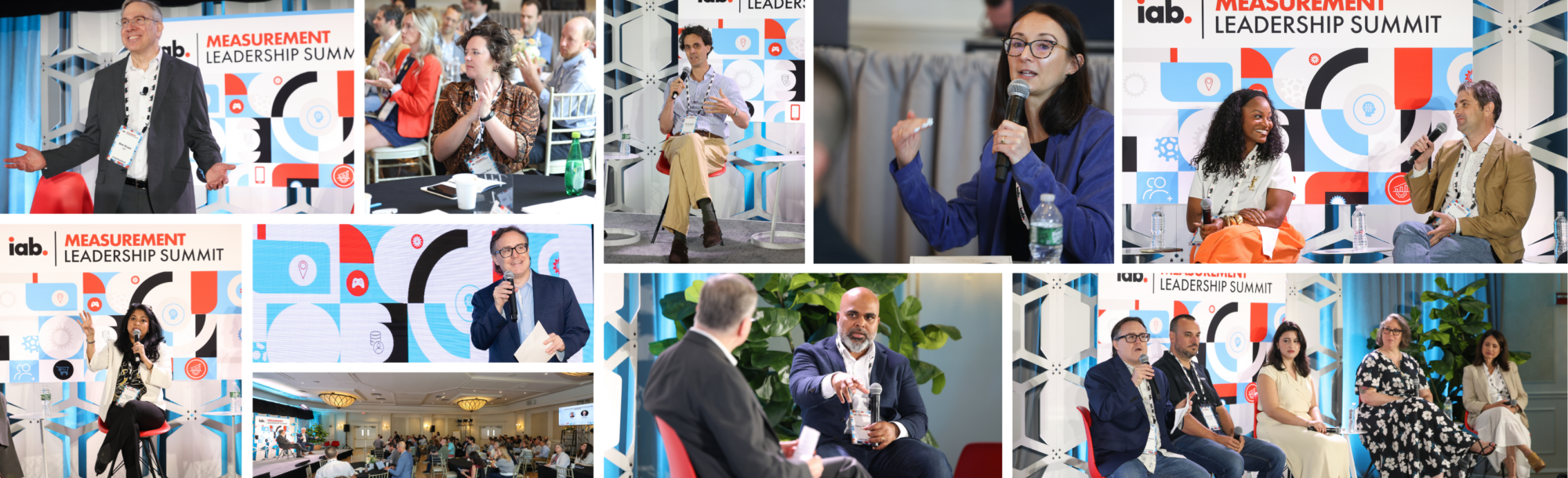
The 2026 IAB Measurement Leadership Summit brought together leaders from across the advertising and measurement ecosystem to examine a central question: how must measurement evolve when AI is not only changing how marketing is executed but also how consumers discover, evaluate, and purchase products? Across presentations, panels, debates, full-room Town Halls, and closing workshops, participants identified eight areas that should shape the industry’s next phase of work.
Executive Summary
The 2026 IAB Measurement Leadership Summit began with a challenge to many of measurement’s longstanding assumptions that served as a foundation for each of the discussions throughout the day: in an agentic marketplace where consumers may delegate research, comparison, and eventually purchase to AI, how must marketing and measurement adapt?
Familiar signals such as clicks, sessions, page views, and other observable paths connecting advertising exposure to conversion may become less visible, while new signals such as inclusion in an AI response, citation share, and agent access gain importance. With this in mind, Summit participants considered how the industry should prepare for a dual-channel reality in which brands must influence both people and the machines acting on their behalf.
An important theme of the event was that current measurement methodologies need not be replaced. The more immediate need discussed by attendees was building a stronger decision system in which existing methods are more suitably and intelligently matched with core business questions. Other core needs that repeatedly surfaced were for measurement providers and platforms to disclose uncertainty and limitations and for brands to use new evidence to learn rather than defend a predetermined answer. These principles connected discussions of MMM, attribution, incrementality, outcomes, data infrastructure, AI visibility, organizational change, and cross-industry collaboration.
1. AI Is Changing the Customer Journey Measurement Was Built to Observe
AI is not simply another efficiency tool for marketers. It is instead becoming a new intermediary between brands and consumers that can research products, compare alternatives, synthesize reviews, recommend a shortlist, and increasingly execute commerce in ways that can compress a shopper journey that once involved advertising exposures, search, social media, publisher content, word of mouth, and multiple site visits into a single conversation.
That does not mean, of course, that those influences will disappear because advertising will not only continue to inform the shopping journey but also shape the preferences and brand associations that consumers bring to an AI interaction. The advent of AI-mediated shopping journeys has, however, created a new measurement blind spot that can’t be ignored, and for which existing measurement frameworks will need to be adjusted.
An agent, for instance, may never encounter an advertisement that influenced a consumer, and the resulting purchase path may contain no observable connection to an original ad exposure.
And while advertising may also influence someone who later creates content or expresses a preference that enters the corpus an AI system uses to advise someone else, it will still be hard to make that connection.
In either case, the commercial impact may be real but difficult to capture through conventional attribution or MMM. Emerging measures designed to address this gap include AI inclusion rate, citation share and depth, corpus presence, and rank stability, while new concepts such as path persistence point to how much further measurement frameworks may need to evolve.
A central implication is that the industry must measure both the human and machine channels, while recognizing that AI’s role will differ substantially by category and consideration level. An autonomous shopping agent may reorder a routine household product, while an LLM may help consumers research, but not actually purchase, a car. Measuring these different journeys may therefore require different combinations of human, AI-assisted, agentic, and outcome signals.
2. Measurement Must Begin With the Decision
A recurring message throughout the Summit was that measurement should work backward from the decision a business needs to make. That process must begin with brands clearly communicating the outcomes they seek and the decisions they need to make to their media and measurement partners. Too often, those needs are not translated into a shared measurement brief, leaving teams to begin with an available dashboard, study, or metric and only later ask what action the result supports. Faster reporting does not solve that problem, but it may accelerate confusion.
Also, MMM, attribution, incrementality, brand lift, attention, platform reporting, and commerce data are not interchangeable sources competing to become a single source of truth. They operate at different levels, over different time horizons, and answer different questions. MMM can help guide strategic allocation, attribution can support ongoing optimization, and incrementality can test a specific causal hypothesis, while brand and attention measures can show effects that take longer to reach sales. When results diverge, the first question should be whether each method was appropriately matched to the question it was intended to answer and whether the methods were expected to produce comparable answers.
The practical requirement is a decision framework that makes clear which method to use when and why, what evidence is sufficient, how uncertainty should be communicated, and which actions the evidence can reasonably support.
3. Outcomes Need a Hierarchy and Shared Accountability
The Summit repeatedly returned to a deceptively difficult question: what is an outcome? Participants distinguished business outcomes such as revenue, market share, customer growth, retention, or lifetime value from the delivery, quality, and consumer-response signals used to evaluate progress toward them. Impressions, clicks, completion rates, attention, site visits, and designated conversion events can be useful and may serve as useful proxies when their relationship to the desired outcome has been validated, but their meaning depends on whether and how they connect to the business change being pursued.
With this in mind, some panelists described the value of using an outcome hierarchy that connects business goals to the areas marketing and media can reasonably influence and then to the signals used for optimization. They noted that this also protects upper-funnel and long-term brand investment from being judged only by short-term conversion metrics. Different outcomes, they noted, unfold over different time horizons in which sales may move within a quarter, brand perception over months, and customer value over years.
And most attendees expressed a belief that no single participant owns the full outcome. Instead, there was broad consensus that brands define their business ambition, agencies translate it into strategy and a measurement framework, publishers and platforms generate exposure and performance data, measurement partners test contribution, and finance evaluates capital allocation. Summit attendees therefore aligned on the idea that accountability must be shared and clearly defined, with each participant contributing the data, context, and expertise needed to understand an outcome that no one party can fully deliver or measure alone.
4. Incrementality Needs a Buyer’s Standard
One of the most important themes to emerge from the summit was the vital importance of incrementality testing as a means of bringing causal evidence into privacy-constrained environments and helping calibrate other models such as MMM. While discussing this theme, however, many attendees felt that incrementality tests should not automatically be used to justify meaningful changes in spend.
Summit participants therefore proposed a measurement contract established before a study begins, with buyers serving as equal partners in the study’s construction, execution, interpretation, action, and postmortem. In such a contract, a buyer and provider would agree on the business question, hypothesis, primary KPI, target, meaningful lift threshold, required confidence, intended action, and which potentially distracting metrics will not be used to reinterpret the result afterward.
Participants also called for radical transparency in which every study makes available its methodology, population and control construction, assumptions, exposure and measurement windows, sample size, statistical power, minimum detectable effect, confidence intervals, weighting or modeling, limitations, and appropriate uses. Executive reporting can summarize business meaning and next actions, while full technical details remain available to analytics teams. It was also felt that providers should retain room for proprietary and media-specific methods but that buyers should always be able to understand how a result was produced and what it can or cannot prove.
5. Agentic Speed Depends on Data, Infrastructure, and Literacy
Another important theme that was identified and explored at the Summit is a rising speed gap in which AI can generate creative, adjust targeting, and execute experiments faster than measurement can evaluate them. Conversations touched on AI’s ability to make some forms of MMM and analysis dramatically faster by synthesizing many signals, querying dashboards through natural language, automating routine reporting, detecting anomalies, and recommending actions, but they also emphasized that many organizations still struggle to act.
The deeper constraints mentioned were fragmented infrastructure, inconsistent taxonomy, inaccessible organizational knowledge, unclear decision rights, and limited data literacy. It was also noted that AI cannot compensate for mislabeled inputs, incomplete exposure data, flawed experiment design, or a team that has not agreed on the business question.
Participants therefore identified practical opportunities including knowledge-management guidance, common prompts for querying measurement data, benchmarks that evaluate whether tools support good decisions, and data-literacy education that helps non-specialists interrogate AI-generated recommendations.
6. The Industry Needs Permission to Fail Forward
One of the Summit’s most important cultural themes was the need to treat unexpected or negative evidence as a learning opportunity. Brands can hesitate to commission a study or incorporate new data when they fear it will make an established model appear broken, but, as many participants explained, a changed estimate does not necessarily mean the model failed. It may mean the model has simply received better information and can now be calibrated more accurately.
Related to that, a lot of discussion at the Summit was tied to the recognition that all measurement is ultimately an estimate in which greater precision comes from testing assumptions, examining confidence intervals, and learning across repeated studies. Several participants therefore emphasized that new data should be welcomed when it reveals double counting, weak controls, incorrect priors, poor execution, or an effect that was smaller than expected. The objective cited was not to preserve a familiar ROI number but to improve the quality of the next decision.
A “fail-forward” culture to protect experimentation and long-term brand building from quarterly pressure was therefore one of the strongest recommendations to come out of the summit. Teams were advised to diagnose why an effort over or underperformed—whether due to creative, audience, availability, timing, exposure quality, or strategy reasons—before declaring an entire channel ineffective. The core takeaway was that measurement should be a continuously tuned learning system, not a simple report card.
7. Brand and Human Influence Still Matter in a Machine-Mediated Journey
Perhaps the most important takeaway from the 2026 IAB Measurement Leadership Summit is that, while AI may shorten the visible path to purchase, it does not make human influence disappear.
Repeatedly, it was pointed out that people will continue to form preferences through advertising, creators, culture, publisher content, reviews, and lived experience, and, as noted above, it was also pointed out that those preferences may shape how they prompt and configure their LLMs or personal shopping agents, even in those instances when they are not directly responding to an advertising message.
This means social content and creators can be both direct influence channels and large repositories of signals that AI systems interpret, and those same systems may help the industry analyze that unstructured content more systematically, connect themes to audiences and brand goals, and improve measurement of influence that has historically been difficult to capture.
With this in mind, another theme of the conference was how important it is to remember that brand building does not move at the speed of light, even if AI can. Many participants emphasized that faster optimization must not force every channel into a short-term performance framework and that AI may help measurement better account for advertising’s carryover effects and for the distinct contribution of high-impact media to eventual business outcomes.
8. Measurement Center and IAB Tech Lab Can Build the Agentic Foundation Together
In the Summit’s closing workshop, IAB Tech Lab’s VP of Product, Jill Wittkopp, connected Tech Lab’s event and conversion level standardization work to the measurement questions the industry now needs to solve. Standards such as the Open Measurement SDK and Event & Conversion API can help establish reliable impression and outcome signals. The next question is what additional connective tissue agentic measurement will require across collection, classification, analysis, and decisioning.
Summit participants therefore considered how the Measurement Center and Tech Lab may have a natural partnership opportunity for 2027 in which the Measurement Center defines business questions, decision frameworks, disclosure expectations, and methodological requirements and Tech Lab helps translate those needs into implementable specifications, APIs, taxonomies, metadata, and interoperability patterns.
Specific potential areas of collaboration include common language and transfer patterns for MMM inputs and outputs, event and conversion metadata that support incrementality and triangulation, a shared prompt library for interrogating measurement data, machine-readable experiment and methodology documentation, and standards that distinguish malicious automation from legitimate commerce agents.
And as bots increasingly research and buy on behalf of humans, the IAB and Tech Lab may be able to parter on helping the industry transition from an invalid traffic oriented, human-versus-bot mindset to a more useful malicious-versus-legitimate or transactional framework.
Potential 2027 Workstreams Raised by the Summit
- An Incrementality Buyer’s Standard, including a pre-study measurement contract, minimum disclosure requirements, statistical guardrails, and clear statements of limitations and appropriate use.
- A triangulation and decision framework that (1) maps business questions to MMM, attribution, incrementality, brand, attention, and other methods and (2) explains what to do when results differ.
- Measurement Center–Tech Lab collaboration on MMM interoperability, event and conversion metadata, taxonomy alignment, machine-readable methodology information, and agent-ready standards.
- A privacy-compliant buy-side/sell-side data-sharing framework focused on the mutual value created by better exposure, outcome, and contextual signals.
- Agentic measurement guidance covering new AI visibility signals, confidence intervals, responsible use of AI-generated recommendations, and the continuing role of human judgment.
- Standards for non-human traffic that distinguish malicious bots, legitimate transactional agents, and emerging attempts by bots to impersonate trusted agents.
- A contributable prompt library, standards for decision-ready measurement, and a data-literacy curriculum developed with IAB Professional Development and relevant councils and committees.
- Collaborative research using real campaign data—including campaigns that underperformed—to identify gaps, validate frameworks, and normalize a fail-forward measurement culture.
Closing Perspective
The 2026 Summit did not point toward one metric, model, or platform that will resolve measurement’s complexity. It pointed toward a more disciplined and collaborative operating system to define outcomes and decisions, establish the right evidence before testing begins, use each method for the question it can answer, make uncertainty visible, and treat new information as an opportunity to improve.
AI raises the urgency because it is accelerating execution while simultaneously changing the customer journey measurement is trying to observe, but it also creates an opportunity. With stronger foundations, shared standards, transparent methods, and closer collaboration across IAB, IAB Tech Lab, and the broader ecosystem, the industry can build measurement that not only keeps pace with but also improves in the agentic era.