
Consumer Skepticism Persists as AI Advertising Expands—But Disclosure Can Close the Gap
Brands are using AI more often in the ad creation process, but for the second year in a row new research from IAB finds that Gen Z and Millennial consumers feel less positive about AI-generated advertising than ad executives think they do. The research also finds that these consumers are receptive to the disclosure of AI use in advertising, which can increase purchase likelihood.
The research, conducted by IAB in partnership with Sonata Insights, is based on a survey of more than 500 Gen Z/Millennial consumers and 100 advertising industry executives using the IAB Insights Engine platform powered by Attest. It builds on the December 2024 IAB/Sonata Insights report “The AI Ad Gap: Why Young Consumers Aren’t Yet Buying Into Gen AI Ads.”
Compared with 2024, more companies are using AI to develop ads in 2026 and more consumers believe they have seen AI-generated ads. But a notable perception gap exists between consumers and advertisers, especially among Gen Z respondents. Disclosure is one area that can help narrow the gap, as many consumer respondents said being aware that an ad was created with AI would increase their purchase likelihood.
The findings indicate that brands have a significant opportunity to educate consumers about how AI is used and to evaluate when and how disclosure can support trust and understanding. The research highlights three principles that can help marketers create more positive consumer experiences with AI:
- Understand audience attitudes toward AI, particularly Gen Z.
- Use AI to enhance creative quality, rather than to produce advertising assets more cheaply.
- Apply consistent disclosure practices, especially when using AI for video and images.
MORE ADVERTISERS ARE EMBRACING AI
AI usage in advertising continues to rise. 83% of ad executives now say their company has deployed AI in the creative process, up from 60% in the 2024 study. Several AI-generated ads have attracted mainstream attention in the past year, including video executions for Kalshi, Volvo, and Coca-Cola, which used AI for a holiday-themed ad for the second year in a row.
Generative AI is now a cornerstone for video ad creation, with 86% of buyers using/planning to use it to build video ad creative, according to IAB’s 2025 Digital Video Ad Spend & Strategy Report. Advertisers in the IAB/Sonata Insights study are most likely to use AI for ads in social media (85%) or display (73%), while 56% use it for TV ads and 42% for audio ads.
Advertiser priorities around AI are shifting. Cost efficiency has emerged as the top benefit in 2026, cited by 64% of respondents, up from being ranked fifth in 2024. Creative innovation remains a plus, with 61% citing it as an advantage in the current study vs. 64% in 2024. The rising importance of cost efficiency is notable. It shows advertisers are applying harder metrics to the use of AI, a sign of maturity. But it also raises questions about whether some advertisers are using AI primarily to reduce production costs, which could undermine quality.
ADVERTISER AND CONSUMER PERCEPTIONS ARE INCREASINGLY OUT OF SYNC
As AI-generated advertising grows, consumer exposure is increasing. 71% of Gen Z/Millennial consumers believe they have seen an ad created using AI, up from 54% in 2024.
Advertiser perceptions of AI don’t align with consumer attitudes. 82% of ad executives believe Gen Z/Millennial consumers feel very or somewhat positive about AI-generated ads, nearly double the 45% of consumers who actually feel that way. This gap has widened from 32 points in 2024 to 37 points in 2026.
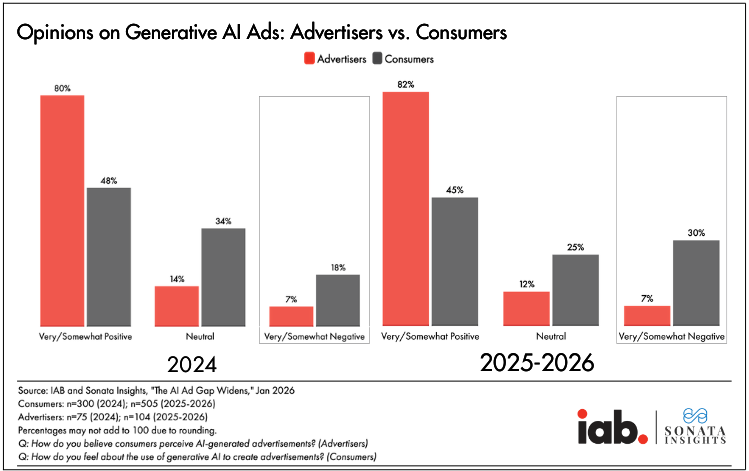
Consumers have become more opinionated about AI ads, but their perceptions haven’t improved. The percentage who feel very or somewhat positive about the use of generative AI to create ads is slightly lower than in the previous study, while the share who feel somewhat or very negative is 12 points greater than it was in 2024. One-quarter of respondents are still on the fence, down from 34% in 2024.
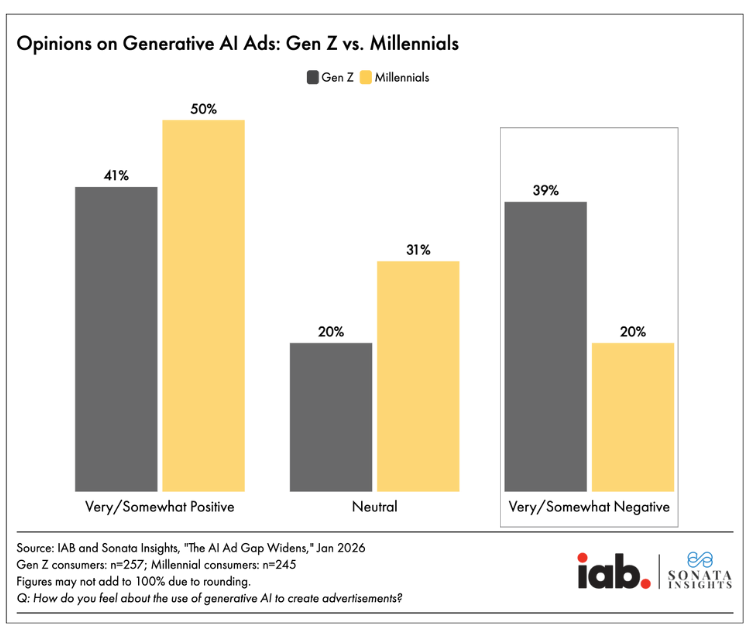
Gen Z consumers are much more likely to have negative sentiment toward AI ads than Millennials. The percentage reporting they feel very or somewhat negative (39%) is now nearly double that of Millennials (20%). In the 2024 study, the gap was significantly narrower (21% of Gen Z respondents felt very or somewhat negative vs. 15% of Millennials).
There’s still a large divide in how consumers and advertising executives describe brands that use AI to generate advertising. As was the case in the 2024 study, consumers are significantly less likely to associate positive attributes with AI-generated advertising and more likely to select certain negative ones.
- “Forward-thinking”: 46% of ad executives vs. 22% of consumers
- “Unique”: 44% of ad executives vs. 26% of consumers
- “Manipulative”: 10% of ad executives vs. 20% of consumers
- “Unethical”: 7% of ad executives vs. 16% of consumers
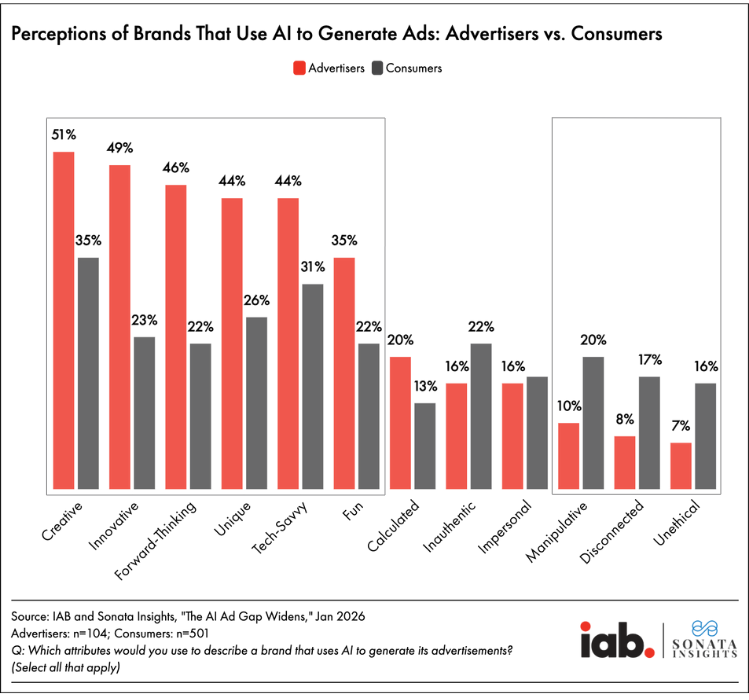
Some sentiment gaps between ad executives and consumers have actually grown wider. For instance, the percentage of consumers calling a brand “innovative” by using AI dropped from 30% in 2024 to 23%, while advertiser belief that AI signals innovation increased from 40% to 49%.
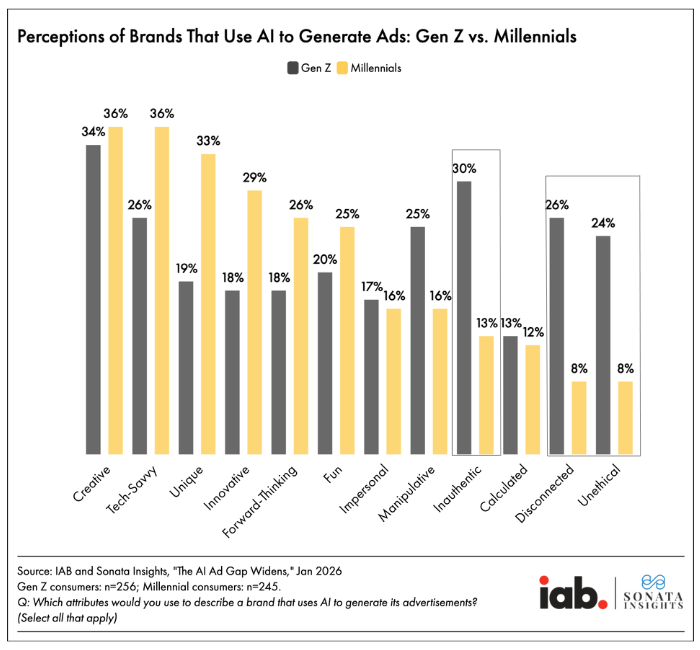
Gen Z consumers describe brands that use AI for ads more negatively than Millennial consumers. Thirty percent call AI-using brands “inauthentic” (vs. 13% of Millennials), 26% “disconnected” (vs. 8% of Millennials) and 24% “unethical” (vs. 8% of Millennials).
Advertisers’ inward-shifting priorities around AI may be a factor in the widening divide between advertisers and consumers. In this year’s study, advertisers are more focused on concerns such as the impact of AI on human creativity, implementation cost and brand authenticity than on consumer perception. In 2024, consumer perception was the second biggest advertiser concern, along with the potential for errors/inappropriate content. Advertisers in the current study also are much less likely to say they have legal or ethical concerns than in 2024.
Advertisers’ inward focus raises risks for consumer perception. Businesses are becoming more attuned to the operational impacts of AI at a time when consumer skepticism is growing.
DISCLOSURE PLAYS AN IMPORTANT ROLE IN SHAPING CONSUMER ATTITUDES
One area that can improve consumer perception is disclosure. Although 89% of advertisers who have used generative AI to create ads at least sometimes disclose, less than half always do, essentially unchanged from 2024.
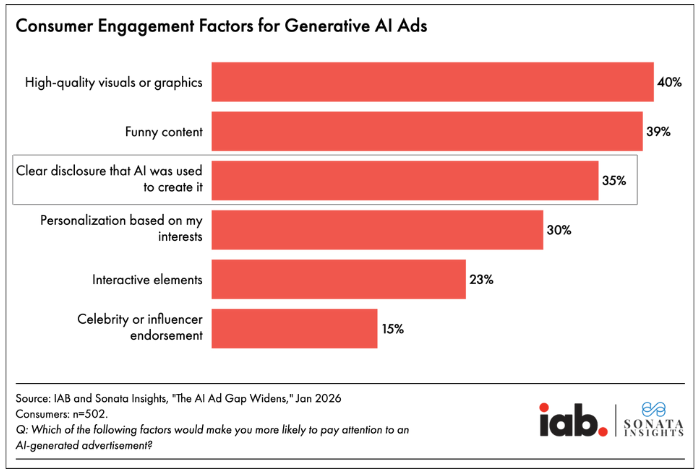
Disclosing AI usage can draw consumer attention to AI ads. In our survey, clear disclosure is the third-highest driver of attention, behind high-quality visuals/graphics and having funny content.
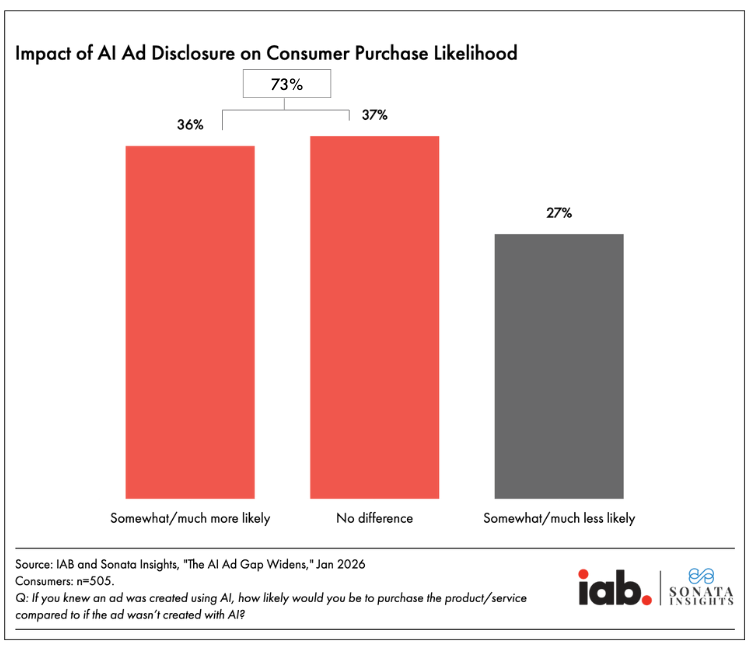
Disclosing also influences purchase consideration. Among Gen Z and Millennial consumers, 73% said if they knew an ad was created with AI it would either increase or have no difference on their likelihood to purchase the product or service. These findings suggest disclosure has more upside than downside when advertising to Gen Z and Millennial audiences.
A MAJORITY OF YOUNGER CONSUMERS WANT AI VIDEO AND IMAGES TO BE DISCLOSED
More than half of consumer respondents want advertisers to disclose if an ad is 100% AI-generated, if it uses AI video or if it has AI images. Nearly half think an advertiser should disclose AI voices or AI avatars/virtual characters.
Consumers are more likely to desire disclosure of these techniques than advertisers are, especially regarding AI video or AI copy.
Some consumers believe other, more commonly used forms of creative manipulation should be disclosed as well. 35% of respondents want digitally adjusted images or video to be disclosed, 31% want manipulated photo techniques to be identified and 23% believe the use of stock photos should be disclosed. Advertisers are fairly aligned with consumers, except when it comes to identifying digitally adjusted visuals.
CONSUMERS WANT DISCLOSURE ACROSS INDUSTRY CATEGORIES — AND ADVERTISERS AGREE
Majorities of advertisers and consumers agree it’s very important to disclose AI usage in common industry categories. In fact, advertisers are more likely to be in favor of this than consumers, especially for financial services advertising. Only about 1 in 10 consumers — and even fewer advertisers — believe it’s not important for any of the industries asked about to disclose AI usage in advertising.
Consumers are most likely to consider it very important to disclose AI usage in pharmaceutical/healthcare or political ads. Advertisers also rank these categories high in importance. They — along with financial services — are categories that are already among the most highly regulated, and some advertisers are choosing to disclose proactively.
Entertainment ads rank lowest in disclosure importance, though a majority of consumers and advertisers still favor transparency.
BEST PRACTICES FOR USING AND DISCLOSING AI IN ADVERTISING
The findings of this study illustrate a widening gap between consumer attitudes and advertiser assumptions about the use of AI in advertising. They also show close alignment on the importance of disclosure. As AI-enabled creative becomes more common, advertisers have a window to strengthen consumer understanding and reshape expectations. Three best practices stand out:
1) Understand audience attitudes toward AI, particularly among Gen Z.
Gen Z consumers’ negative sentiment toward AI-generated advertising is stronger than Millennials’. While they are heavy users of AI in their personal lives, they are more skeptical of how brands use AI in marketing. Campaigns targeting this generation will require more-nuanced creative decisions. Advertisers should also prepare to be open about sharing the reasons for using AI.
2) Use AI to enhance creative quality, rather than focusing on accelerating production of advertising assets alone.
One-quarter of consumers remain neutral about generative AI in advertising, meaning their views are still forming. Advertisers that focus on cost efficiency benefits alone should know that it can’t come at the sacrifice of quality. As discussions around “AI slop” grow, brands should apply AI to boost creative quality, not cheapen it.
3) Apply consistent disclosure practices, especially when AI is used for video and images.
While advertisers say disclosure of AI usage is very important across industry categories, less than half of advertisers always disclose. When AI creates material risk that consumers will be misled about what they’re seeing, hearing or interacting with, advertisers should disclose. Clear, standardized disclosure protects consumers from deception and maintains advertiser credibility, which is essential to long-term brand trust. For detailed guidance on when and how to disclose AI usage, refer to the IAB AI Transparency and Disclosure Framework.
SUMMARY
Advertisers are rapidly increasing their use of AI in advertising creation, but attitudes among Gen Z and Millennial consumers have grown more negative, especially among Gen Z. The gap between advertiser perception and consumer sentiment continues to widen. However, with clearer communication, an emphasis on high creative standards and more consistent disclosure practices, advertisers may be able to improve consumer attitudes toward AI-generated advertising and experience a positive impact on attention and purchase likelihood.
Survey Methodology
This research was conducted using the IAB Insights Engine platform, powered by Attest. It included a survey of 505 US Gen Z (16-27) and Millennial (28-43) consumers who engaged with ads and 104 US ad industry executives who work for companies with annual media spending of at least $1 million to over $1 billion. The survey was conducted between October 2025 and January 2026. The comparison survey of 300 US Gen Z/Millennial consumers and 75 US ad industry executives was conducted between August and October 2024.