IAB Successful at Supreme Court
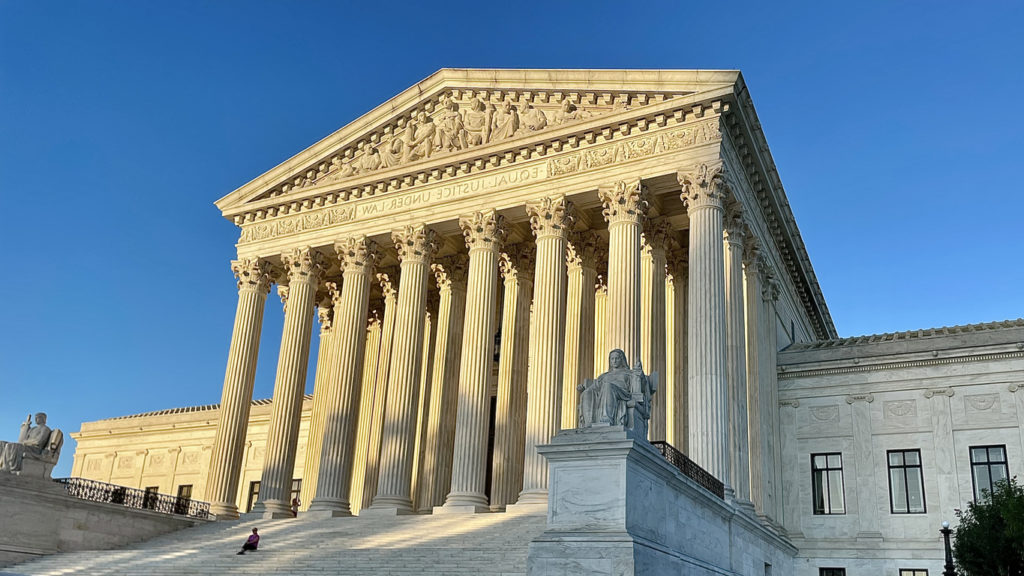
A Texas law that would have restricted social media companies’ First Amendment rights to moderate user content failed at the Supreme Court this week, after IAB joined dozens of organizations in an amicus brief contesting the law. The Supreme Court’s order temporarily suspends Texas House Bill 20, while lower courts consider its constitutionality. Federal courts have struck down similar legislation in Florida, but the issue of online speech and content moderation is far from resolved. In our amicus brief, or “friend of the court” filing supporting litigants NetChoice and the Computer and Communications Industry Association, IAB expresses our concern that content threatening public safety or spreading false information would harm not only internet users but also companies who advertise to them. A healthy online environment is as important to social media companies’ reputations as it is to brands appearing on popular platforms – their own reputations and revenue. IAB will continue to fight for private companies’ First Amendment rights, brand safety, and a flourishing digital advertising industry.
Related Coverage:
IAB Joins NAACP, Others, Backing Legal Challenge to Texas Social Media Law (NextTV)
Competition in Digital Ad Markets
The “Competition and Transparency in Digital Advertising Act” might sound nice, but the Senate bill to break up integrated online advertising services would reverse decades of progress towards scale and efficiency in digital ad markets. Affecting not only the largest technology companies, the bill would also place heavy restrictions on any company offering both ad-buying and ad-selling services, as well as online exchanges facilitating the transactions. Instead of increasing competition, it would fracture digital technologies that have enabled small and independent businesses to reach large audiences at low cost, compared to traditional media, and which support a giant new industry of content creators and media publishers.
Small advertisers with limited resources would confront a jumble of disconnected options, demanding more time and expertise, and larger brands could also experience cost increases, not to mention the effect on brands and media companies offering their own integrated services. In reality, digital advertising is a competitive and growing space attracting new entrants and investment, a trend the “Competition and Transparency in Digital Advertising Act” completely overlooks. According to IAB’s study “The Economic Impact of the Market-Making Internet,” the ad-supported internet is a dynamic environment where the most successful companies change places frequently.
While it might achieve its authors’ political aspirations, the legislation threatens innovation across the digital advertising industry, as well as American consumers who enjoy free, ad-supported services such as email, search and navigation. Ironically, it may violate a key tenet of competition law, the “consumer welfare standard,” because the average consumer could face higher prices for goods and services and weaker data privacy. IAB will continue to advocate for healthy competition in a growing digital advertising industry that benefits everyone – and against the mis-named “Competition and Transparency in Digital Advertising Act.”
IAB Opposes Petition to Ban Data-Driven Advertising
IAB supports efforts to stop unfair and deceptive business practices. That’s what the Federal Trade Commission should be doing with limited resources, not re-writing the law to regulate the internet. But that’s exactly what a shadowy political organization is urging the FTC to do – outside the independent commission’s constitutional authority.
In response to a recent petition to the FTC to ban “surveillance advertising,” IAB warns the consequences of slapping a false label on the reasonable use of data could be disastrous. Not only do online media consumers and shoppers appreciate the customization and convenience of data-driven advertising, but the ad-supported internet also subsidizes free services such as search and email Americans value at over $30,000 per person annually.
It’s simply false that personal advertising degrades the online experience. Our industry enables a thriving commercial internet, supports media publishers, and meets the needs of consumers who expect tailored suggestions. It’s true, however, we need to do a better job educating the public and policymakers about digital advertising’s contributions to jobs, the economy, and progress.
Without the exchange of data, the internet as we know it wouldn’t exist. Maybe that’s what opponents want – a restricted version with lower-quality content and less choice for the average American. Informed customer consent, accountability and transparency are key, if our industry is going to overcome legislation and regulation threatening 17 million U.S. jobs and trillions of dollars of economic output. See the details in IAB’s full FTC filing here.
Related Coverage:
FTC Should Use Limited Resources to Modernize Law Protecting Children’s Online Privacy Says IAB Policy Chief (MarketWatch)
“Surveillance Advertising” Law Illegal?

IAB is pushing back against bills in Congress like the “Banning Surveillance Advertising Act” which would raise costs and lower revenue for brands, publishers, platforms, and more across the entire digital ecosystem. Representative Debbie Lesko (R-AZ) read IAB’s letter to House Energy & Commerce Committee leaders into the official record, announcing her surprise that not a single advertising industry representative had been invited to a hearing about the bill. She voiced her support for small businesses who will pay the price if it passes. In our letter, IAB makes a powerful case for the social, cultural, economic, and personal benefits of the ad-supported internet.
Fortunately, only a few Members of Congress have signed on to the bill. Its chances of passing are slim. But the “Banning Surveillance Advertising Act” signifies a growing movement to outlaw common advertising practices virtually every industry employs. The bill’s language is so broad, it could penalize even first-party data, and it’s easy to envision religious institutions, women’s organizations, and civil rights groups running afoul of a prohibition on advertising to “protected classes,” a First Amendment concern. A “private right of action” would open the floodgates to litigation against even the most careful advertisers.
Opponents of “surveillance advertising” seem to have bigger targets in their sights than the digital advertising industry. Such legislation and regulation would have profound consequences for every American. Instead, IAB supports a federal privacy law providing easy-to-understand principles for data protection, which fosters innovation, economic growth, and an enjoyable online media experience.
Related Coverage:
Ad Pros Predict Unintended Consequences of “Surveillance Advertising Bill” Would be Severe (The Drum)
Small Businesses Rally in Support of Digital Advertising

The “Big Tech” debate in Washington, D.C., hits home for small business owners relying on the ad-supported internet to succeed in a competitive economy. Hundreds have joined Internet for Growth to help lawmakers understand the stakes for everyone from the corner baker to the local jewelry maker, who could be swept up in poorly informed federal legislation. A complicated patchwork of state privacy laws is making it difficult for entrepreneurs and creators to serve customers across the country.
Ironically, legislation like the “Banning Surveillance Advertising Act” and similar measures at the FTC would entrench the largest companies, punishing the smallest without the same resources. Digital advertising and marketing provided a lifeline to Main Street during COVID-19 lockdowns, but policymakers are considering eliminating one of the most cost-effective methods. The latest census data shows a resurgence of start-ups in 2021 despite the odds, thanks to e-commerce and other data-driven technology. Internet for Growth is fighting for their ability to survive.
Since its launch early this year, the grassroots coalition has received national press attention, attracted diverse members in almost every state, and generated thousands of letters to Congress promoting digital advertising and opposing legislation that would harm Main Street. During Small Business Week, Internet for Growth appeared at the Digital Advertising Summit. Protocol Media interviewed small businesses and content creators concerned about potential laws targeting “Big Tech” that would have unintended consequences for innovators and entrepreneurs. Millions of Americans rely on digital advertising and marketing to earn their livelihoods: Internet for Growth is sharing their stories.
Related Coverage:
Digital Advertising Critical to Small Businesses in New Era of E-Commerce (Richmond Times-Dispatch)
Small Firms and Self-Employed Create More Internet Jobs than Largest Companies (Axios)
Activity in the States
While IAB continues to advocate for Congress to pass a comprehensive federal privacy law, we have also been busy advocating against a complicated patchwork of state privacy rules and regulations emerging across the U.S. IAB submitted letters in opposition to proposed legislation in Alaska, Connecticut, Florida, Maryland, Massachusetts, Nebraska, New York, and Washington.
EU Data Agreement Takes Shape

When European courts struck down a data transfer agreement between the U.S. and the E.U. in 2020, the decision left many American businesses in limbo. Seventy percent of those who had relied on the former “Privacy Shield” to avoid penalties were small businesses. Appearing with the European Union Commission President in Brussels, President Joe Biden recently announced a new Trans-Atlantic Data Privacy Framework designed to protect EU citizens’ data in the U.S. and ensure the continued flow of information underpinning over $7 trillion of transcontinental trade.
The new deal is an agreement only “in principle” and will likely face challenges from European privacy advocates, who have also lodged complaints to EU regulators about IAB Europe’s Transparency and Consent Framework (TCF). IAB’s sister organization designed the TCF to help businesses cope with the General Data Protection Regulation (GDPR), a 2016 law subjecting any company controlling and processing EU citizens’ data to strict scrutiny. Among its many requirements, GDPR mandates that an individual must give informed consent to data collection. Data must be secure, pseudonymous, and erasable, which advocates describe as human rights.
EU regulators are still interpreting the law’s meaning. While proponents argue GDPR protects human rights, decisions such as eliminating the Privacy Shield suggest the law may be a form of economic protectionism. What’s clear is that GDPR has had negative economic consequences for businesses of every size on both sides of the Atlantic, and IAB Europe’s good faith effort to mitigate the confusion has placed the trade association in an unfair position.
IAB Europe is appealing a recent ruling by the Belgian Data Authority defining it as a “controller” of data subject to fines. IAB Europe is a small non-profit that developed the TCF in consultation with EU authorities to help everyone understand GDPR. It’s no wonder that in this unpredictable environment European companies are reporting lower investment. According to one survey, tech professionals say GDPR is the biggest obstacle to innovation. Others say it’s impossible to implement. Consumers are even more confused.
We at IAB support our friends at IAB Europe working hard for the digital advertising industry, and we’re working here in the U.S. to prevent laws like the GDPR from hobbling our domestic economy. A federal privacy law setting easy-to-follow guidelines for businesses and consumers, simplifying a complex patchwork of state laws, is IAB’s most important policy goal.
Get Involved
IAB holds regular meetings with members of its Public Policy Council. If you are interested in getting involved, please email Lartease Tiffith, EVP, Public Policy at [email protected].
Upcoming Events
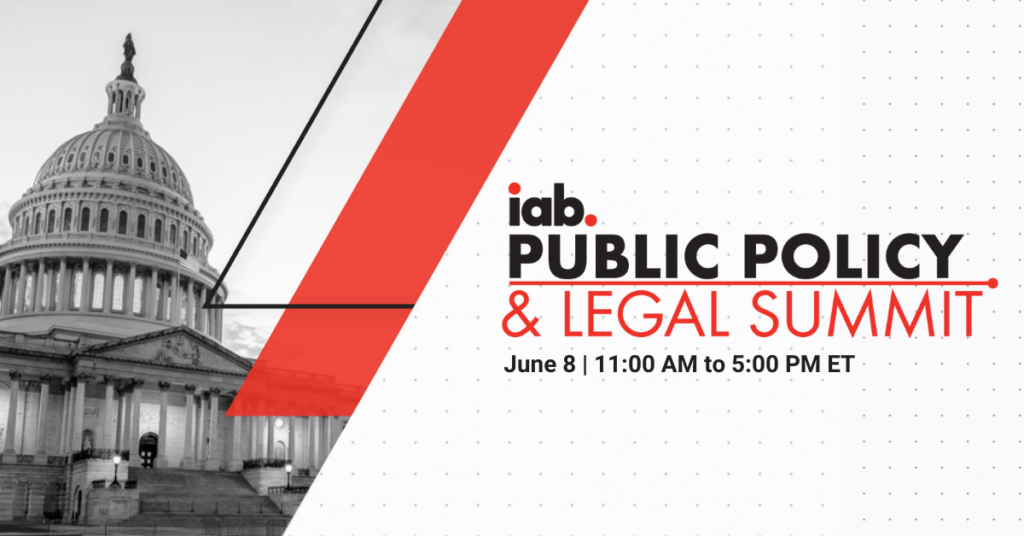
IAB Public Policy & Legal Summit
June 8 | 11:00 AM to 5:00 PM ET
The IAB Public Policy & Legal Summit 2022 brings together global leaders in advertising, media, technology, and the government to discuss how organizations can lean into the coming transitions and find solutions that will enable them to build a sustainable and consumer-centric media and marketing ecosystem.