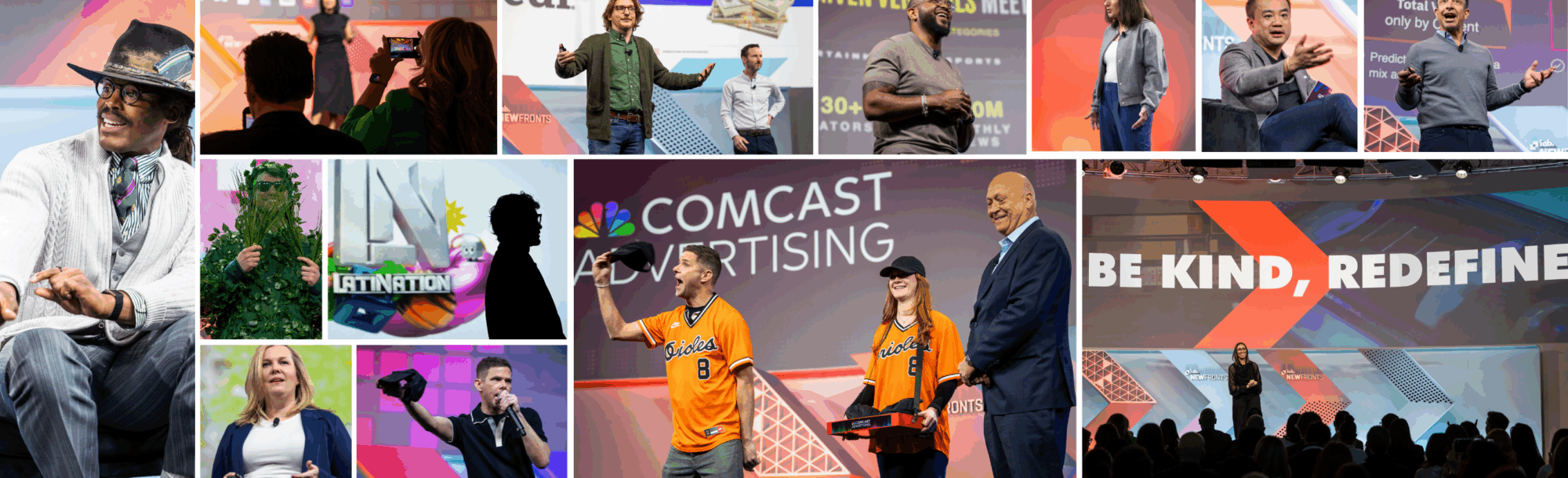
There is a phrase that kept surfacing across the IAB NewFronts stage this year, spoken in different ways by different companies, but pointing at the same idea: the old model is over.
Not the old model of television. Not the old model of digital. The old model of both, the one that treated reach as a proxy for results, that measured success in impressions rather than outcomes, that kept brand building away from performance and treated video channels such as Linear and CTV as separate. That model served the industry well for decades, but 2026 is the tipping point when the ecosystem finally showed that there is something better.
What emerged across the NewFronts wasn’t a collection of individual company announcements. It was a coherent argument, made by publishers, platforms, data companies, retailers, and measurement innovators alike, that the video ecosystem has crossed a decisive threshold. The intelligence is here. It’s time to move beyond delivering just impressions and start focusing on delivering business outcomes.
Measurement Has Left the Building—And Entered the Machine
For years, one of the most persistent frustrations in digital video advertising has been the gap between the promises it makes and what it can prove. Streaming drives brand recall. Commerce media shapes purchase intent. Creator content moves culture. Everyone in the industry believed this. Almost nobody could demonstrate it fast enough, rigorously enough, or simply enough to satisfy a CFO looking at the campaign’s media results.
That gap is closing.
The shift begins with AI applied not as a feature but as an operating layer. Company after company revealed measurement architectures around artificial intelligence: systems that don’t just analyze campaigns after the fact, but that predict outcomes before spend, optimize in flight, and report at the speed decisions actually need to be made.
We saw a wide range of presentations and approaches during the IAB NewFronts week. Upwave’s AI agent “Bayes” turns campaign questions that once required days of analyst time into real-time answers, available 24/7, mid-flight or post-campaign. Comcast’s Outcomes+ platform and new partnership with MasterCard connects impression data directly to transaction behavior, giving premium video the kind of purchase-level proof that performance channels have long used to justify investment. DoubleVerify and Spectrum Reach both approached accountability through transparency at the content level. For advertisers looking to unlock the reach of live news, Anoki, LG Ad Solutions, Allen Media (Local Now), and Spectrum Reach are deploying real-time AI that analyzes content at the segment level, making news a scalable, contextually intelligent buy. Google used its NewFront to launch a live sports biddable suite inside DV360, engineered specifically to handle the millions of individual bid requests that fire in under a second during a live streaming commercial break. And LG Ad Solutions unveiled its “Own the Outcome” framework, new home-screen ad formats available programmatically, paired with post-exposure measurement designed to connect CTV campaigns to on-screen conversions and business results.
IAB’s own research set the stakes clearly. According to IAB’s 2026 State of Data report, 60 to 75 percent of advertisers say widely adopted measurement solutions, incrementality, attribution, MMMs, still miss on rigor, speed, and efficiency. More to the point, 41 percent of advertisers say CTV is underrepresented in their marketing mix models, and 37 percent say the same of OLV. These are channels that are proven to build reach and brand favorability, and they’re being systematically under-credited by the models that determine where budgets go. The implication, according to the research, is that AI-driven improvements in advanced measurement could unlock $26 billion in total media investment within two years, not by growing the pie, but by correctly crediting what’s already working.
Retail and Video Are No Longer Adjacent. They’ve Become Each Other’s Best Growth Lever
If measurement was the most common storyline on the IAB stage, the convergence of retail and video was the most structurally significant.
For the better part of a decade, retail media and video advertising have been discussed as parallel industries, one built on purchase data and proximity to conversion, the other built on reach, emotion, and brand equity. The assumption was that these could be connected eventually, as tools and standards matured. What the NewFronts demonstrated is that “eventually” arrived.
Albertsons Media Collective presented what a fully converged retail-video ecosystem looks like in practice. Their “couch to checkout” framework is operational infrastructure connecting first-party loyalty data from 47 million members across CTV, display, social platforms, and in-store environments, all measured back to actual purchase behavior. Cadent brought the convergence argument into the planning layer, introducing their Total Video Predictor which is a forecasting tool that models the optimal media mix across linear, CTV, and YouTube simultaneously, removing the siloed thinking that forces advertisers to optimize channels independently rather than as a unified system. Comcast announced a strategic partnership with Amazon Ads to give local and small-to-medium-sized business (SMB) advertisers access to premium Prime Video inventory for the first time. Walmart and Vizio made a significant announcement: a unified account login that connects Walmart’s 150 million weekly customers directly to their Vizio smart TVs, creating a closed-loop system that ties streaming ad exposure to verified purchase behavior, and eventually enables viewers to shop Walmart inventory without ever leaving the TV screen. Early results are already validating the model, with one campaign delivering 98% incremental household reach beyond linear. Google added Kroger to its Commerce Media Suite inside DV360, introducing SKU-level sales reporting that connects a DV360 impression to a specific product purchase at the retailer, the kind of granular attribution CPG advertisers have been requesting from retail media for years. And Samsung launched a direct integration with Amazon DSP that brings Amazon’s Interactive Video Ad technology to Samsung TV Plus, letting viewers add products to their Amazon cart from the living room screen, with access to Amazon Marketing Cloud signals for full-funnel measurement across the buy.
The retail-video story is really a story about better data. The argument being made here is that first-party purchase data, the kind tied to real buyers, real transactions, and real loyalty programs, is more accurate and more trustworthy than what digital advertising has historically relied on. It doesn’t exist everywhere yet. But where it does, across retailer loyalty programs, distributor household data, and the identity tools being built across the ecosystem, the advantage is hard to ignore.
Creators and Culture Are the New Prime Time
Perhaps the most important reframing at the IAB NewFronts was the one that happened most quietly: the industry stopped treating creators as incremental reach opportunities and started treating them as a primary asset.
Revolt’s Off Script platform, anchored by Kenya Barris and a roster of 150 creators including Cam Newton and Zoe Spencer, challenged brands to stop placing advertising around culture and start becoming part of it. Entrepreneur Media launched a creator/influencer network for small business audiences; branded content woven into founder stories; distributing through Yahoo Finance’s new Builders Hub. Latin Nation made the economic case for the bilingual Gen Z and millennial Latino audience, representing $4 trillion in spending power by 2030, an audience hiding in plain sight that most media plans still systematically miss. Future Today’s Fawesome and Happy Kids demonstrated that creator-to-CTV distribution delivers audiences that other streaming giants simply don’t reach, with a Great Wolf Lodge case study showing 156 percent higher booking rates and 64.8 percent incremental reach among households unexposed on linear. And Tripadvisor showed what it looks like when first-party intent data and cultural intelligence converge, connecting brands to 200 million monthly travelers at the precise moment they’re making decisions. YouTube rebranded its BrandConnect platform as YouTube Creator Partnerships and embedded it directly into YouTube Studio, Google Ads, and DV360, turning creator-brand matchmaking from a manual workflow into a scaled, AI-powered infrastructure. Gemini now surfaces relevant creators from more than 3 million channels in the YouTube Partner Program, while a new “creator partnerships boost” lets brands take authentic creator content and run it as paid media across Shorts and in-stream placements. TikTok announced new premium formats, including Logo Takeover, Prime Time sequential ads, and TopReach. Samsung TV Plus and LG Channels, both launched creator-led original programming, is becoming a serious content strategy for OEMs. Samsung announced a docuseries with Keanu Reeves and a live global event with Mark Rober, while LG revealed new creator partnerships with Jubilee Media, a Gen Z-targeted streaming destination through Portrait TV, and original programming spanning comedy, culinary, and fantasy sports, all available through FAST channels.
Together, these presentations made one thing unmistakable: with creator economy ad spend growing faster than the broader media industry, the companies treating creators as the programming layer are the ones defining what video means in 2026.
What All of This Means for the Marketplace
Step back from any individual announcement and the picture that emerges is striking. The companies that presented at IAB NewFronts: publishers, platforms, data innovators, retail media networks, measurement companies, and content creators, have spent the last several years building something that doesn’t yet have a clean name but has a very clear shape. It is an ecosystem that:
- Can match the targeting precision that marketers demand, with full transparency into where every dollar goes.
- Can prove business outcomes as rigorously as any performance channel, without sacrificing the brand environment, editorial integrity, and cultural relevance that make video worth buying in the first place.
- Delivers creator authenticity, cultural specificity, and audience depth in meaningful ways.
And it does all of this transparently. With verified data. Independent measurement. Deterministic attribution. And a growing willingness, demonstrated across NewFronts presenters to put performance guarantees in writing..
The companies that presented at IAB NewFronts 2026 are not asking marketers to take their word for it. They are offering the proof through the case studies, the benchmark data, the third-party validation, that make the video ecosystem a structurally superior one for any marketer who values accountability alongside reach.
The IAB NewFronts take place annually in New York City. All provided sessions from the 2026 IAB stage are available on demand at iab.com.