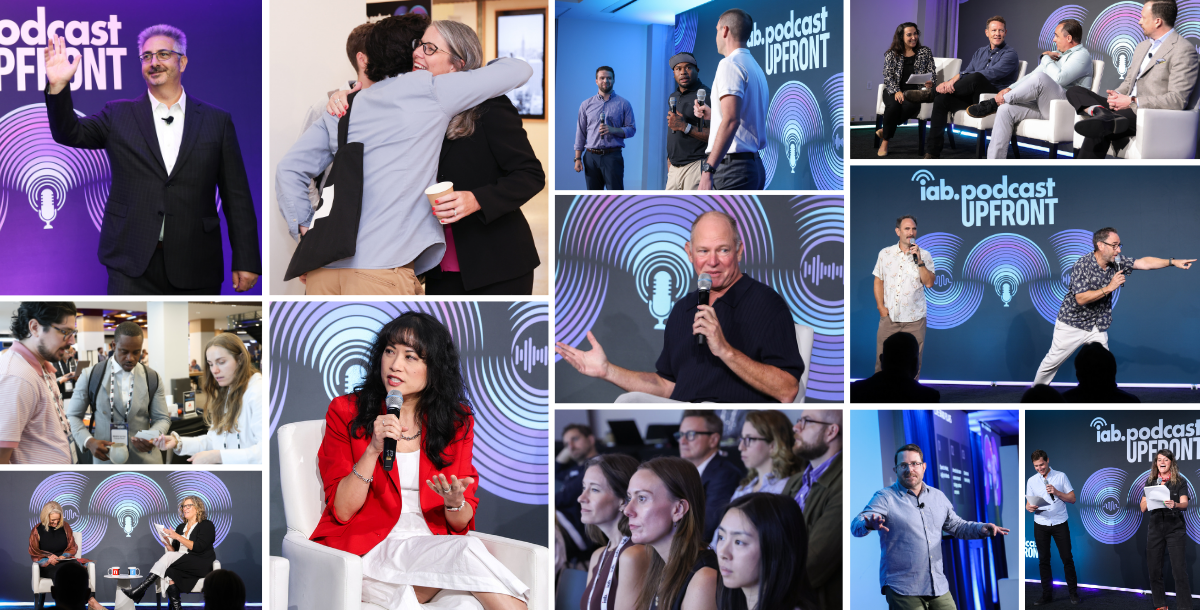
At the 2026 IAB Podcast Upfront, the industry spent the day describing a medium that is growing up. Podcasts no longer live in a single feed. Content now moves through RSS, HLS, YouTube, Spotify video, Rumble, FAST, VOD, social clips, and live events, and audiences pick whichever surface fits the moment. What holds that audience together is not the show but the creator, and publishers are building their businesses around that relationship in very different ways. Each surface is also taking on a distinct job, with clips driving discovery and content, audio building trust, and video capturing attention. Behind the scenes, the buying infrastructure is consolidating, pulling more supply into fewer pipes. And measurement has not kept pace with any of it, not because the industry lacks numbers, but because the definitions behind them keep shifting. Those four forces, the creator, the surface, the pipe, and the metric, shaped the 2026 Podcast Upfront.
The Creator is at the Center
Audiences follow creators across platforms and formats, and publishers are building their businesses around that relationship: selling on the fit between host and audience rather than on inventory alone, and recruiting established talent rather than developing it only. Strategies diverge, though. Some companies are concentrating on a small roster of top creators to win scale and chart position. Others argue that the right 100 listeners beat 100,000 downloads, and they are building niche, high-value audiences that command premium CPMs.
Every Format Has a Job
Podcasts now move across RSS, YouTube, Spotify video, FAST, VOD, social clips, and live events, and context, not preference, decides which format the audience picks. Clips drive discovery, with 81% of listeners saying a clip led them to a specific episode. Audio builds trust and carries the lowest skepticism of any format. Video captures attention and drives action. New research showed that adding visuals to the same audio ad lifted unaided awareness from 39% to 68%. Gen Z data showed podcasts serving as a personal surface, while broadcast radio remains the shared one.
Supply is More Readily Available for Both Buyers and Consumers
Even as distribution splits, the buying pipes are merging. Amazon moved major podcast supply into its DSP, making SiriusXM, Spotify, Acast, and iHeart buyable together, and video is next. Publishers serve ads dynamically on YouTube via Google’s ad server. They are also building single distribution points into Apple, Spotify, YouTube, Tubi, and FAST, where new surfaces reach new audiences rather than shift existing ones. HLS is emerging as the route to bringing programmatic creative closer to host-read quality, though only 4% of the top 500 shows are HLS-enabled today.
The Measurement Problem Is Not Missing Numbers. It Is Unstable Definitions.
The industry does not lack numbers; it lacks consistent definitions. Difficulty measuring ROI remains the top reason buyers hold back on digital audio. YouTube’s move to a zero-second view inflates counts by roughly 1.8x, and every surface counts differently, from Spotify’s thirty-second play to Apple’s HLS reach and attribution. Downloads still cannot confirm that a listener reached the ad, and incrementality methods remain fragmented. The bond between creator and audience, which everyone sells as their differentiator, is still unmeasured.
How It Fits Together
Taken together, the four themes describe a podcast ecosystem with more momentum than ever. Creators have become omni-channel brands, and their audiences follow them across every format, opening new paths for discovery and reach. Each format adds something unique: clips attract new fans, audio builds trust, and video drives action, so brands that use all of them can capture it all. The buying infrastructure is keeping pace with DSPs, ad servers, and content aggregators, making these audiences easier to buy against at scale than ever before.
Measurement is the next frontier, and momentum is currently building behind it. Buyers can now reach a creator’s audience across nearly every format, and the industry has the opportunity to align on shared definitions for things such as clips, views, plays, and sessions, and on how to measure when someone switches between viewing and listening. Solving these will give the buyers the confidence needed to invest in the channel at scale and take it to the next level. That is the path ahead for 2027.